
Riccitelli Milano develops and manufactures modest fashion in Italy for brands in the Gulf and worldwide. Abayas, kaftans, jalabiyas, covered eveningwear and modest ready to wear, made in the same ateliers and from the same mills that serve the houses on the European luxury calendar. A brand hires us and we produce the collection, answering for the result at every stage.
Modest luxury has outgrown the workshops that first served it. A brand competing at the level of an international fashion house needs the construction, the cloth and the finishing of one, and that is a production capability rather than a design decision.
What we produce in modest fashion
Abayas. Open and closed, from the architectural and minimal to the heavily worked. Where the garment lives or dies is the fall: an abaya is essentially a study in how cloth moves around a body that is not shown, so weight, drape and hand matter more than they do in almost any other garment. We cut in crepes, silks, wool blends and technical fabrics chosen against how the piece has to hang, and we build the shoulder and the sleeve so the line holds when the wearer moves.
Kaftans. From resort weight silk to fully embellished occasion pieces. Kaftans read as simple and are not: the whole garment rests on proportion, on where the volume breaks and on how the neckline and the sleeve relate to it, because there is no fitted seam to correct a mistake.
Jalabiyas and house pieces. Everyday and occasion, in the finishes that survive real wear and repeated cleaning.
Covered eveningwear and couture. Long sleeves, high necks and full length worked to the standard of our eveningwear and couture production: internal structure, hand finishing and the atelier techniques that make an occasion garment sit correctly rather than merely cover.
Modest ready to wear. Coats, dresses, separates, wide trousers and layering pieces built with modest proportion in the pattern rather than adapted from a standard block afterwards, which is the difference between a modest collection and a lengthened one.
Embellishment. Hand embroidery, beading, sequin work, appliqué and metallic thread through our embroidery and embellishment specialists. And silk scarves and shaylas printed and finished in Como, where the industry’s best printers work.
Why produce modest fashion in Italy
Because the technical problems modest luxury has to solve are the ones Italian production solves best.
The first is cloth. A garment that covers is read almost entirely through its material, so the fabric is doing the work that a silhouette does elsewhere. We buy from the Italian houses that supply the best tailoring rooms in the world, and we choose weight and finish against the specific behaviour the piece needs rather than from a swatch book. See our fabric sourcing service.
The second is drape, which is a pattern making problem. A long garment magnifies every error: two centimetres wrong at the shoulder becomes a visible twist at the hem. Our pattern makers work the way the couture ateliers do, drafting, cutting, hanging the piece and correcting until it falls clean.
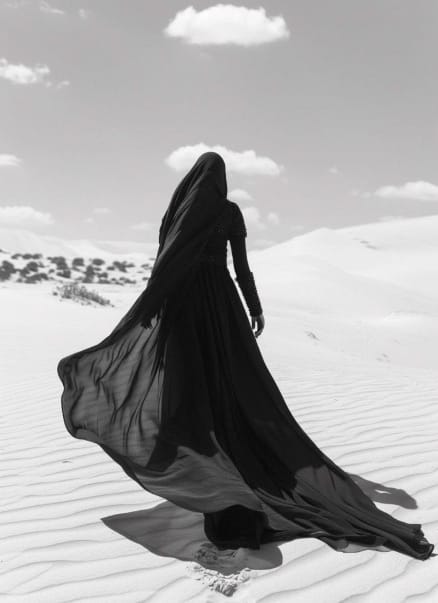
The third is finishing. Modest garments are worn close to the skin over long hours and are seen at close range when seated. Seam finishing, linings, hems and closures are not details there, they are the product.
And provenance. Made in Italy carries the same weight in Riyadh, Doha and Dubai that it carries in Paris and New York, and for a modest brand competing on quality rather than on price it is the credential that settles the argument.
Who we produce for
Modest luxury labels in Saudi Arabia, the United Arab Emirates, Qatar, Kuwait, Bahrain and Oman building collections at an international standard. Established fashion houses opening a modest line or a Ramadan and Eid capsule. Designers launching a first range and choosing to launch small rather than badly. Retailers and concept stores developing an own label. International brands adapting existing collections for Gulf customers.
The whole process runs in English. Most of the brands we produce for are based outside Italy, samples and corrections travel, and fittings are handled remotely when a client cannot be in Milan.
How a modest collection is built
Concept and design. Where the collection is going, who it is for and what it has to say. Research, references and fabric ideas gathered before anything is drawn, then a collection plan setting how many styles, which categories and how the range holds together.
Materials and sourcing. Weights, finishes and hands compared against what each garment has to do. Trims, linings, closures and labels sourced alongside the cloth. Shrinkage and colour fastness tested, quantities booked in time, consumption measured on the real garment rather than estimated on paper.
Technical development. Flats drawn to scale, first patterns drafted by hand or in CAD, then cut, hung and checked, and the base size graded across the full range. Everything lands in a tech pack that makes the garment repeatable next season.
Sampling and fit. First prototype, fitting, corrections back into the pattern, second sample, size set proven across the range, then the approved sample that production has to match. See sampling and prototyping.
Production. Cutting, making in the workshop where that product is made best, quality control against the approved sample at every stage, then pressing, labelling, packing and delivery to your warehouse or straight to the accounts that ordered.
Ramadan and Eid calendars
Occasion collections for Ramadan and Eid carry a fixed date that moves earlier each year, and they concentrate a season’s demand into a few weeks. That makes the calendar the hardest part of the project rather than the making.
We build backwards from the date you have to deliver, so cloth booking, sampling and production sit where they have to sit. Embellished pieces are the constraint: hand work cannot be compressed, and a heavily worked kaftan needs its weeks. In practice a Ramadan capsule should be in development the previous autumn, and a full collection earlier still.
Quantities
Minimums are set against what each garment actually requires rather than a single number applied to everything, because an embellished occasion piece and a plain crepe abaya carry completely different constraints. That is how a modest brand can launch a capsule collection at a sensible scale and grow the run once it proves itself. Read more about low minimum order production.
We also produce the technical end of modest dressing: modest sportswear and sport hijabs and modest swimwear and burkinis.
Frequently Asked Questions
Can abayas and kaftans be produced in Italy?
Yes, and the technical problems they present are the ones Italian production is strongest at. A garment that covers is read through its cloth and its fall, which makes fabric quality and pattern making decisive. Both are what the Italian supply chain exists to deliver, and the same ateliers that build couture eveningwear build these pieces.
Do you understand modest construction, or do you adapt standard patterns?
Modest proportion is built into the pattern from the start. Lengthening a standard block produces a garment that is longer but not modest: the shoulder, the sleeve head, the volume break and the neckline all have to be drafted for how the finished piece is worn and seen. That is a pattern making decision taken before the first sample, not an alteration afterwards.
Which fabrics work best for abayas?
It depends entirely on the fall you want. Heavy crepes hold an architectural line, silks and lighter crepes give movement, wool blends give structure and weight for cooler months, and technical fabrics can give a clean drape with easier care. We choose against how the garment has to behave rather than from a swatch, and we test shrinkage and colour fastness before booking.
Can you produce a Ramadan or Eid capsule in time?
Yes, if the calendar is built backwards from the delivery date. Embellished pieces are the binding constraint because hand work cannot be compressed. A Ramadan capsule should be in development the previous autumn, and a full collection earlier. Tell us the date you have to hit and we tell you what is achievable.
What quantities do you need for a modest collection?
Minimums are set per product rather than per client. An embellished occasion kaftan and a plain crepe abaya do not carry the same constraints, so we quote each against what it actually requires and place it in a workshop suited to that run.
Do you handle embroidery and beading?
Yes, through the Italian specialists who do this work for couture houses. Hand embroidery, beading, sequin work, appliqué and metallic thread, developed on the sample and then repeated to that reference across the production.
Who owns the designs and patterns?
You do. The designs and the patterns we develop for your brand belong to you, and your collection is produced exclusively for your label. We treat every relationship with full discretion.
Do you work with brands in Saudi Arabia and the Gulf?
Yes. Most of the brands we produce for are based outside Italy and come here for the making. The whole process runs in English, samples and corrections travel, and fittings can be handled remotely when you cannot be in Milan.
Produce your modest collection in Italy
Send what you have, a sketch, a reference, a fabric or a finished tech pack, and we tell you what it takes to build it: which ateliers, which cloth, what calendar. Contact our Milan studio, or see the full range of fashion production services.
Leave your details and continue to the project form. Your answers are saved as you type, so you can stop and come back to it.