
Riccitelli Milano manufactures activewear and athleisure in Italy for fashion brands: leggings, bras and tops, technical outerwear, sweats, joggers and the elevated loungewear that sits between sport and ready to wear. Activewear is the only category in fashion where a garment can be beautifully made and still fail, because it has to perform on a moving body and survive being washed twice a week.
We are a fashion production agency in Milan. A brand hires us and we produce the collection, answering for the result at every stage.
Why activewear is a different discipline
The fabric is the product. In tailoring the cloth serves the construction. In activewear it is the other way round: stretch percentage, recovery, opacity under tension, moisture behaviour and hand all decide whether the garment works, and they are properties you test rather than admire.
Recovery beats stretch. Everyone checks how far a fabric stretches. What matters is whether it comes back. A legging that bags at the knee after an hour has failed, and that only shows in a made up garment worn for a while, not in a swatch pulled between two hands.
Opacity under tension. A fabric that is opaque flat can go sheer when stretched over the body. This is the single most common product recall in the category, and it is caught by testing the real garment on a real body in a squat, not by looking at the roll.
Seams do the work. Flatlock and coverstitch seams lie flat against skin and stretch with the fabric; a standard lockstitch will snap. Bonded and seamless construction remove the seam altogether and need entirely different machinery.
What we produce
Leggings, cycling shorts and tights. Sports bras and tops, from light support to structured. Technical jackets, gilets and windbreakers. Sweats, hoodies and joggers in heavier loopback and brushed cloth. Elevated loungewear and travel pieces. Modest activewear with full coverage cuts, long sleeves and longer lines, developed properly rather than lengthened after the fact, which connects to our modest fashion production.
Team and club apparel runs through sportswear and team apparel, swim pieces through swimwear and beachwear.
Fabric and finishing
We source performance knits from the Italian mills that supply the technical end of the market, and the specification matters more here than the name: composition, weight in grams per square metre, stretch in both directions, recovery after repeated extension, and the finish. Recycled polyamide and polyester, and biodegradable elastane alternatives, are available and increasingly asked for by buyers.
Finishing decides the rest. Antibacterial and moisture management treatments, colour fastness to chlorine and to perspiration, and pilling resistance are all tested before booking rather than after delivery. See fabric sourcing in Italy and quality control and compliance.
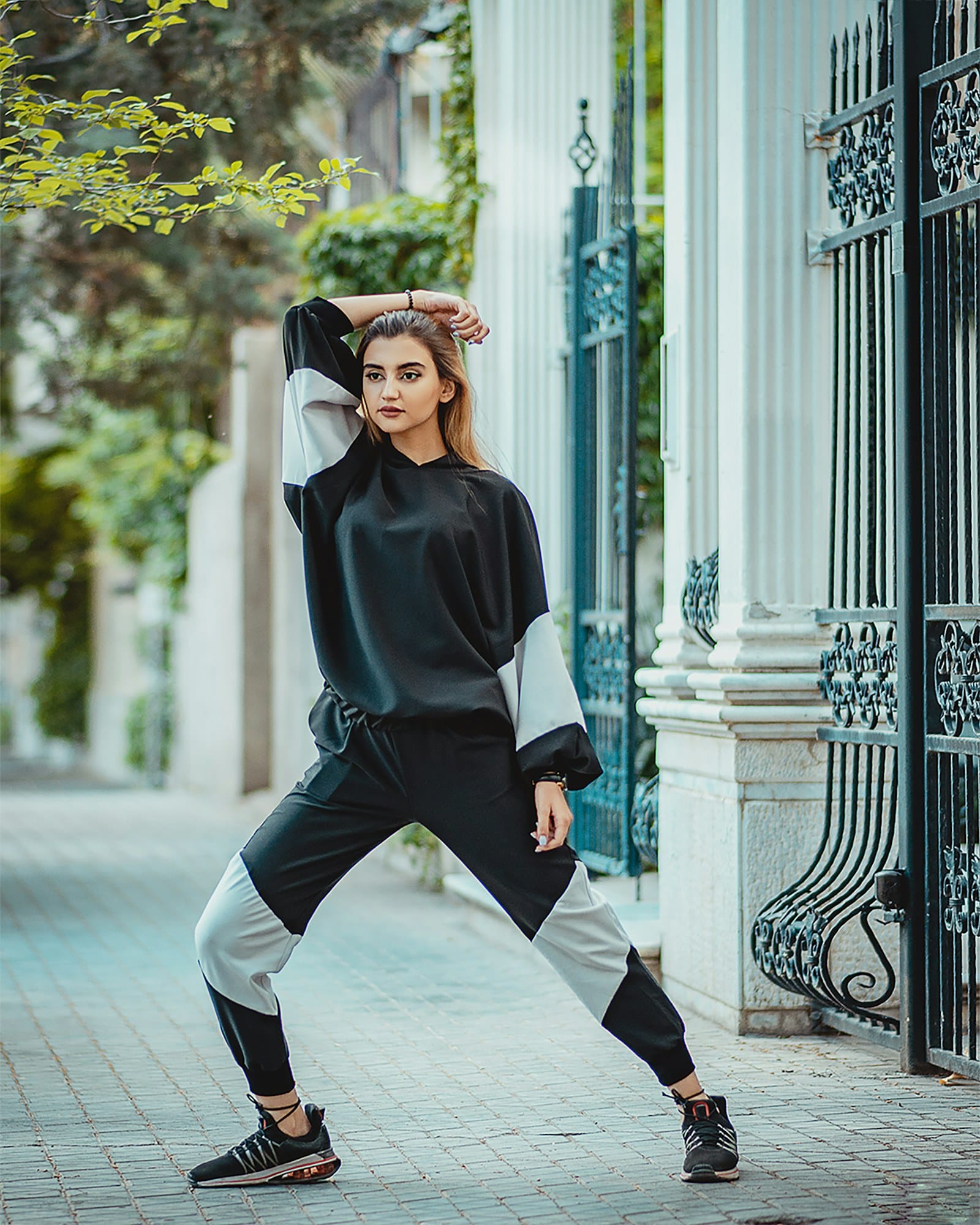
How an activewear project runs
Flats drawn with every seam type specified, because in this category the seam is a design decision. First patterns drafted with negative ease calculated against the specific fabric, since a pattern is only correct for the stretch it was built for. The prototype is then worn and moved in: squat, reach, run. Corrections go into the pattern, a second sample confirms them, the size set proves the grading, and the approved sample becomes the production reference. See pattern making and sampling.
Quantities
Minimums follow the fabric more than the garment, because performance knits are dyed in lots. See low minimum order production and capsule collections.
Frequently Asked Questions
What makes activewear harder to produce than normal clothing?
The fabric leads instead of following. Stretch, recovery, opacity under tension and moisture behaviour decide whether the garment works, and the pattern has to be drafted with negative ease calculated for that specific fabric. A pattern correct for one knit is wrong for another of the same weight.
Why do leggings go sheer?
Because a fabric that is opaque lying flat can open up when stretched over the body. It is the most common failure in the category and the only reliable test is the real garment on a real body in a squat, before production rather than after.
What is the difference between flatlock and coverstitch?
Flatlock joins two pieces with no ridge, so the seam lies flat against the skin and stretches with the fabric. Coverstitch finishes hems and edges with the same stretch. A standard lockstitch will snap under extension, which is why the seam type has to be specified on the flat rather than left to the factory.
Do you produce modest activewear?
Yes, and it is developed rather than adapted. Full coverage cuts, long sleeves and longer lines have to be built into the pattern from the start, because lengthening a standard block gives you a longer garment that still does not work when the wearer moves.
Can you use recycled and sustainable performance fabrics?
Yes. Recycled polyamide and polyester are established, and biodegradable elastane alternatives are available. Buyers increasingly ask for the certification alongside the fabric, so we source both together.
What quantities do you need for activewear?
Minimums here follow the fabric rather than the garment, because performance knits are dyed in lots and the lot size is the constraint. Tell us the styles and colours and we tell you what is workable.
How long does an activewear collection take?
Usually four to six months, with more of that time in fabric selection and testing than in making. Getting the cloth right is most of the project, and it cannot be compressed without accepting the risk it is meant to remove.
Produce your activewear in Italy
Send a reference garment, a fabric or a finished tech pack and we tell you what it takes to build it. Contact our Milan studio, or see all fashion production services.
Leave your details and continue to the project form. Your answers are saved as you type, so you can stop and come back to it.