
Riccitelli Milano manufactures leather apparel in Italy for fashion brands: jackets and blousons, shirts and overshirts, trousers and skirts, dresses, suede pieces and shearling. Leather is the only garment material that cannot be corrected after the cut, which is why it separates producers more sharply than any other.
We are a fashion production agency in Milan working with the leather ateliers in Tuscany and the north. A brand hires us and we produce the collection, answering for the result at every stage.
Leather does not forgive
There is no seam allowance to let out. Once a piece is cut, every needle hole is permanent. A seam cannot be unpicked and moved, because the holes stay. This is why leather is fitted in calico first, always, and why a producer who cuts skins against an unproven pattern is gambling with the client’s money.
Every skin is different. Hides vary in thickness, grain and stretch across a single skin and between skins in the same lot. Leather from the back is firm, from the belly it stretches. A cutter who places pieces wherever they fit produces a jacket where one sleeve grows and the other does not.
Natural marks are not defects. Scars, insect bites and growth marks are part of a real hide, and the yield calculation has to account for them. Yield is what actually drives cost in leather, not the price per square foot, and it is decided by how the pattern is nested on the skin.
Skins must be matched. A jacket cut from three hides of slightly different tone reads as a mistake. Skins are selected and matched before cutting, and lots are kept together through production.
Thickness decides the garment
Leather is specified in millimetres, and that number is the whole design brief. Around 0.6 to 0.8 for a soft nappa shirt or dress that has to drape. Around 0.9 to 1.2 for a jacket that needs to hold structure while staying wearable. Above that for outerwear and biker constructions where weight is part of the intent.
A pattern drafted for one thickness does not work at another, because thicker leather needs more room at every seam and behaves differently around a curve. Choosing the skin and drafting the pattern are the same decision.
What we produce
Jackets, blousons and bikers in nappa, lamb and calf. Shirts, overshirts and dresses in fine nappa. Trousers and skirts. Suede pieces in lamb and goat. Shearling and lined outerwear. Perforated, laser cut, quilted and embossed treatments. Colour and finish work: aniline, semi aniline, patent, metallic and washed effects.
Leather outerwear runs alongside our leather outerwear and jackets page, bags and small goods through leather goods and bags, and belts and gloves through fashion accessories.
Construction
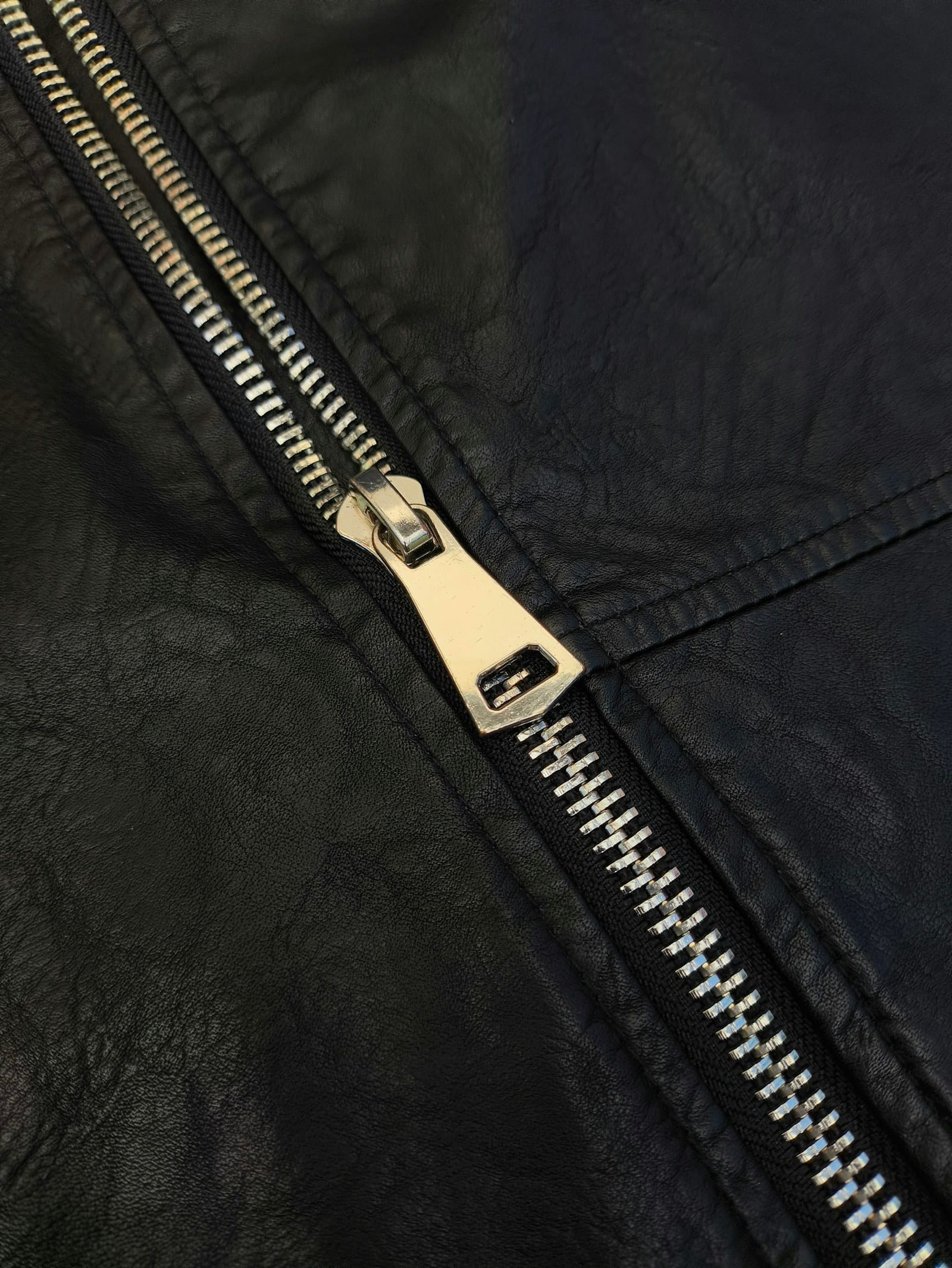
Seams are skived so the leather thins at the join and does not build bulk. Edges are folded, bound or left raw depending on the effect, and each choice changes the pattern. Linings are cut with their own ease so they never pull against the leather. Zips and hardware are chosen for weight as well as look, because a heavy zip on a light nappa will distort the front edge over time.
Pressing is done cold or with controlled heat, since leather cannot be steamed the way cloth can. Every stage is checked against the approved sample. See quality control and compliance.
How a leather project runs
Technical drawings with thickness, finish, hardware and edge treatment specified. A calico toile made and fitted before a single skin is cut. Pattern corrected, then a leather prototype in the real skin. Skin selection and matching, nesting planned for yield, then cutting, skiving, assembly and finishing, with quality control at every stage. See pattern making and sampling and prototyping.
Quantities
Leather is naturally suited to smaller runs, because it is cut piece by piece rather than laid in long markers. See low minimum order production and small batch production.
Frequently Asked Questions
Why must a leather garment be fitted in calico first?
Because every needle hole in leather is permanent. A seam cannot be unpicked and moved, the holes stay, and there is no allowance to let out. The pattern has to be proven in cloth before any skin is cut, and cutting against an unproven pattern is how a collection loses its margin.
What thickness of leather should I use?
Around 0.6 to 0.8 millimetres for a soft shirt or dress that has to drape, 0.9 to 1.2 for a jacket that holds structure while staying wearable, and heavier for outerwear and biker constructions. The pattern has to be drafted for that thickness, because thicker leather needs more room at every seam.
Why does where the leather is cut matter?
Because a hide is not uniform. Leather from the back is firm and from the belly it stretches, so pieces placed wherever they fit produce a jacket where one sleeve grows and the other does not. Placement is a skilled decision, not a convenience.
Are natural marks in leather a defect?
No, they are evidence of a real hide. Scars, insect bites and growth marks are normal and are accounted for in the yield calculation, which is what actually drives cost in leather rather than the price per square foot.
What is skiving?
Thinning the leather along a seam so the join does not build bulk. Without it a leather garment looks heavy and lumpy at every seam, and it is one of the clearest signs of whether a piece was made by a leather atelier or by a garment factory.
Can leather be steamed or pressed?
Not the way cloth can. Leather is pressed cold or with carefully controlled heat, because steam and high temperature will mark and shrink it permanently. It is one of the reasons leather runs in its own workshops.
Can you produce leather apparel in small quantities?
Yes, and leather suits smaller runs better than most categories because it is cut piece by piece rather than laid in long markers. The minimum follows the skin selection more than the garment count.
Produce your leather collection in Italy
Send a reference garment, a skin or a finished tech pack and we tell you what it takes to build it. Contact our Milan studio, or see all fashion production services.
Leave your details and continue to the project form. Your answers are saved as you type, so you can stop and come back to it.